Always-on sensing
Keyword spotting, wake-word detection, and vibration monitoring where a device must listen continuously on a battery for months rather than hours.
Neuromorphic computing builds hardware that processes information the way nervous systems do: many simple units exchanging sparse, event-driven spikes, with memory sitting beside the computation instead of behind a separate memory bus. The point is not biological fidelity. It is that activity-proportional computation uses far less energy than clocking dense arithmetic over data that mostly has not changed.
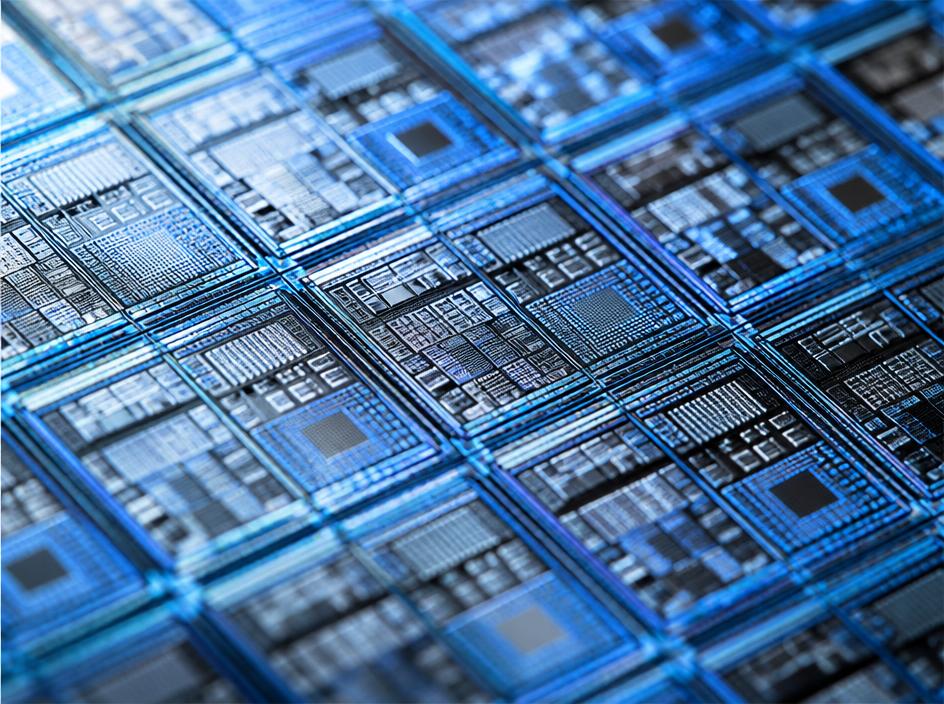
A conventional network passes continuous activation values through every layer on every inference. A spiking neural network encodes information in the timing and sparsity of discrete events, so a unit that has nothing to say stays silent and costs nothing. Information lives in when spikes arrive and how often, not in a floating-point number recomputed each cycle.
That changes the economics of inference. On conventional hardware the dominant cost is usually moving data, not arithmetic. Neuromorphic designs attack that directly by co-locating synaptic weights with the circuits that use them and by only doing work when an event occurs.
Neither is a general replacement for the other. Neuromorphic hardware wins where inputs are sparse, power is scarce, and latency matters; dense accelerators remain the right tool for training and for batch throughput.
Keyword spotting, wake-word detection, and vibration monitoring where a device must listen continuously on a battery for months rather than hours.
Event cameras already emit sparse per-pixel changes, which maps naturally onto spiking hardware and avoids reconstructing full frames just to discard them.
Tight sensorimotor loops benefit from low, predictable latency and from computation that stays near the sensor rather than crossing a bus.
Systems that are mostly idle and occasionally interesting suit a substrate whose power draw follows the data rather than the clock.
The centre operates an analog neuromorphic testbed with per-core energy measurement and matched baselines on conventional edge hardware. External researchers can propose a workload and run it with the Neural Architecture group.